Business Advice,
Coding,
COVID19,
Enterprise,
Guides,
Healthcare,
Our News,
Public Sector,
Sector,
SME,
Software,
Topics
Online Booking vs Manual Scheduling: Which Saves More Money?
July 8, 2026
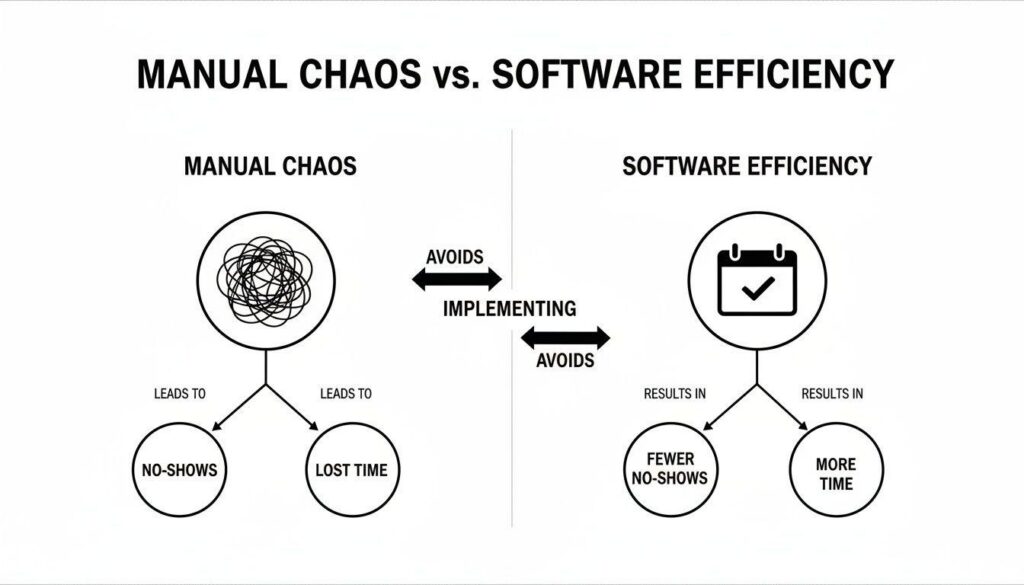
Every organisation relies on efficient appointment scheduling, whether it's a local council, school, healthcare provider or private business. However, many organisations continue to rely on manual booking methods such as telephone calls, emails, spreadsheets and paper diaries.
While these traditional processes may seem inexpensive, the hidden costs quickly add up.
Online appointment booking software automates many of these tasks, helping organisations reduce administration, minimise missed appointments and improve productivity. But which approach really saves more money?
Let's compare the two.
The Hidden Costs of Manual Scheduling
Manual scheduling involves far more than simply writing appointments into a diary.
Administrative teams often spend hours each week:
Answering booking enquiries by telephone.
Responding to emails.
Updating calendars manually.
Sending appointment confirmations.
Chasing missed appointments.
Rearranging cancelled bookings.
Correcting scheduling errors.
These repetitive tasks consume valuable staff time that could be spent delivering services or supporting customers.
How Online Booking Reduces Costs
1. Less Time Spent Booking Appointments
Online booking allows customers to schedule appointments themselves 24 hours a day.
Instead of staff handling every booking, the system automatically manages availability, confirmations and calendar updates.
The result is fewer telephone calls and a significant reduction in administrative workload.
2. Fewer Missed Appointments
No-shows cost organisations both time and money.
Modern booking systems automatically send email and SMS reminders, helping customers remember appointments or reschedule if they can no longer attend.
Improved attendance means fewer empty appointment slots and better use of staff resources.
3. Reduced Administration
Routine tasks such as sending confirmation emails, updating diaries and processing cancellations are completed automatically.
This frees administrative teams to focus on higher-value activities rather than repetitive manual work.
4. Improved Staff Productivity
Because appointments are booked directly into live calendars, employees spend less time managing schedules and more time delivering services.
Managers also benefit from better visibility of workloads and resource availability.
These insights help organisations make informed decisions and improve operational efficiency.
Cost Comparison
Manual Scheduling
Online Booking
Staff answer every booking enquiry
Customers book online 24/7
Manual confirmations
Automatic email & SMS confirmations
High risk of double bookings
Real-time availability
Manual diary updates
Automatic calendar synchronisation
Time spent chasing no-shows
Automated reminders reduce missed appointments
Limited reporting
Real-time reporting and analytics
Over time, these efficiencies can significantly reduce operating costs while improving customer satisfaction.
Beyond Financial Savings
The benefits of online booking extend beyond cost reduction.
Organisations also experience:
Faster customer service.
Improved resident and customer satisfaction.
Better accessibility through 24/7 booking.
Reduced paperwork.
Easier compliance with data protection requirements.
Greater flexibility for remote and hybrid teams.
These improvements create a more professional and modern service experience.
Choosing the Right Appointment Booking Software
When evaluating appointment booking software, look for features including:
Online self-service booking.
Email and SMS reminders.
Microsoft Outlook and Microsoft 365 integration.
Google Calendar integration.
Multi-staff and multi-location scheduling.
Reporting and analytics.
Mobile-friendly booking pages.
Secure cloud hosting.
UK GDPR compliance.
Selecting software with these capabilities helps maximise return on investment while supporting future growth.
Conclusion
Although manual scheduling may appear inexpensive, the hidden costs of administration, missed appointments and inefficient processes often make it the more expensive option.
Online appointment booking software reduces these costs through automation, improved communication and better resource management. Organisations benefit from increased productivity, higher appointment attendance and a better experience for customers and staff alike.
Whether you're a business, school or local authority, switching to online booking is an investment that delivers measurable savings and long-term operational improvements.
We use cookies on our website to give you the most relevant experience by remembering your preferences and repeat visits. By clicking “Accept”, you consent to the use of ALL the cookies.
This website uses cookies to improve your experience while you navigate through the website. Out of these, the cookies that are categorized as necessary are stored on your browser as they are essential for the working of basic functionalities of the website. We also use third-party cookies that help us analyze and understand how you use this website. These cookies will be stored in your browser only with your consent. You also have the option to opt-out of these cookies. But opting out of some of these cookies may affect your browsing experience.
Necessary cookies are absolutely essential for the website to function properly. These cookies ensure basic functionalities and security features of the website, anonymously.
Cookie
Duration
Description
cookielawinfo-checbox-analytics
11 months
This cookie is set by GDPR Cookie Consent plugin. The cookie is used to store the user consent for the cookies in the category "Analytics".
cookielawinfo-checbox-functional
11 months
The cookie is set by GDPR cookie consent to record the user consent for the cookies in the category "Functional".
cookielawinfo-checbox-others
11 months
This cookie is set by GDPR Cookie Consent plugin. The cookie is used to store the user consent for the cookies in the category "Other.
cookielawinfo-checkbox-necessary
11 months
This cookie is set by GDPR Cookie Consent plugin. The cookies is used to store the user consent for the cookies in the category "Necessary".
cookielawinfo-checkbox-performance
11 months
This cookie is set by GDPR Cookie Consent plugin. The cookie is used to store the user consent for the cookies in the category "Performance".
viewed_cookie_policy
11 months
The cookie is set by the GDPR Cookie Consent plugin and is used to store whether or not user has consented to the use of cookies. It does not store any personal data.
Functional cookies help to perform certain functionalities like sharing the content of the website on social media platforms, collect feedbacks, and other third-party features.
Performance cookies are used to understand and analyze the key performance indexes of the website which helps in delivering a better user experience for the visitors.
Analytical cookies are used to understand how visitors interact with the website. These cookies help provide information on metrics the number of visitors, bounce rate, traffic source, etc.
Advertisement cookies are used to provide visitors with relevant ads and marketing campaigns. These cookies track visitors across websites and collect information to provide customized ads.